
A celebrated Chinese landscape designer has developed an international portfolio distinguished by thoughtful treatment of public space and increasing responsibility for complex landscape projects.
From Shanghai’s celebrated waterfront to California’s public parks and the vast landscapes of Saudi Arabia, Minghao Zhao gives his work both visual character and a strong connection to the people who experience it. Raised in Chengdu, Zhao once imagined creating landscapes in cities around the world.
At a time when investment in public space is an increasingly important driver of urban renewal and regional development, his projects show how landscape design links public value and economic value.
Currently, a landscape architecture designer at SWA’s Los Angeles studio, Zhao brings a sensitivity to materials, forms, and spatial relationships.
His research on AI infrastructure extends his design perspective to spaces shaped by technological development.
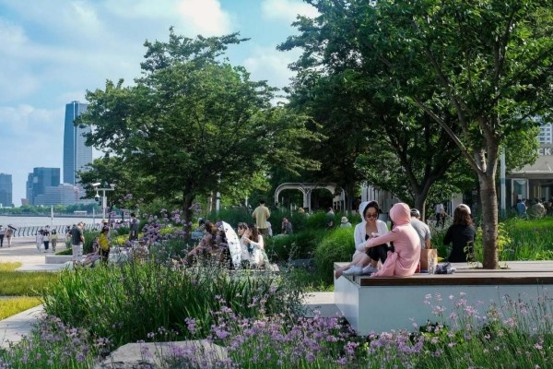
One of Zhao’s early achievements came at Hassell’s Shanghai studio in 2021, where he contributed to the West Bund Waterfront Public Realm on the Huangpu River. For one section of the riverfront, Zhao designed a family of planters with gentle contours and a lush color palette. Each planter has its own character within a cohesive composition, bringing calm, rhythm, and warmth to the waterfront.
According to Hassell, since the waterfront opened in 2021, daily visitor numbers have peaked at 40,000, making it one of Shanghai’s most popular waterfront destinations. The project received the Landscape Architecture Award in the International category at the Australian Institute of Landscape Architects 2023 National Landscape Architecture Awards, an important early milestone in Zhao’s international career.
After joining SWA in Los Angeles in 2022, Zhao worked on Irvine Great Park, one of Southern California’s most ambitious municipal park developments, with a planned area of approximately 1,300 acres. Working on the Bosque, he strengthened the connections between the surrounding community and the park’s facilities, including its sports venues. Zhao designed paving patterns that complemented the adjacent structures and helped select understated, locally rooted stone, giving visitors a sense of cohesion as they move through the park.
At Live Oak Park in Temple City, California, the city hoped to preserve the playground’s distinctive rocket. The estimated construction budgets for the playground renovations at Live Oak Park and Temple City Park total approximately $3.9 million, funded by the federal American Rescue Plan Act. Zhao and his colleagues developed a space-exploration concept, imagining the playground surface as a galaxy of planets. Approaching the project from a child’s perspective, Zhao helped shape elevated areas, recessed nooks, and changing levels that invite children to climb, run, and explore. He also contributed to nearby Temple City Park, where a bamboo-forest theme inspired a nature-oriented playground.
Zhao’s professional responsibilities grew considerably at Wadi Safar, a major master-planned development near Riyadh, Saudi Arabia. Wadi Safar is part of the wider Diriyah development plan, bringing together luxury hotels, branded residences, and golf and equestrian facilities. In 2024, the client, Diriyah Company, awarded construction contracts worth approximately $2.13 billion for the district, reported to be the company’s largest single construction contract at the time. Serving as team captain, Zhao advanced the designs of several extensive project areas, including South Fairways, carrying each round of revisions through successive stages of three-dimensional development and managing much of the modeling and documentation independently.
The role required him to balance design judgment with project management, and marked a significant progression in his career.
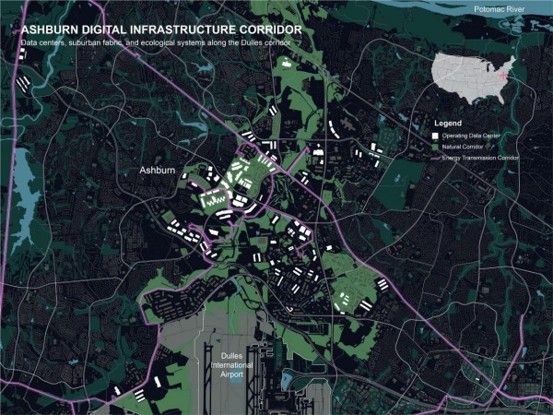
Zhao has also examined the spatial consequences of emerging technologies. In September 2026, the American Society of Landscape Architects published “AI Data Centers Are Reshaping Landscapes. But Who Is Designing Them?”, an article Zhao co-authored with Zhimin Ma for THE DIRT. Using Ashburn, Virginia — located in Loudoun County, which according to county government information has the world’s highest data center density — as a case study, the authors examined how rapid data center development has produced fragmented landscapes of fences, utility corridors, isolated green spaces, and disconnected drainage areas. Zhao developed the maps illustrating these developments. The authors proposed linking roadside setbacks into public pathways, introducing meadows along transmission corridors, combining stormwater facilities into shared wetlands, and turning neglected parcels into community spaces.
ASLA later featured the article on its official Instagram account, and a landscape architecture lecturer at California State Polytechnic University, Pomona, invited Zhao to a design studio’s final review.
In October 2026, Zhao gave a guest lecture at the University of Florida on how artificial intelligence is influencing landscape design. The lecture and the response to his published research reflect growing interest in his perspective on the future of landscape architecture.
Looking ahead, Zhao continues to assume significant responsibilities at SWA, including serving as one of the lead designers on a confidential project associated with an upcoming world-class exposition.