
As APEC economies put growing emphasis on digital health and AI-enabled care, the question of how new technology moves from the show floor into clinical practice is drawing more attention. COA 2026, China’s largest annual orthopedics congress in Guangzhou, offered a timely answer: the industry’s competitive focus is shifting from standalone product breakthroughs to systems and ecosystems. Great Robotics is a telling example.
Ecosystems become the clinical direction
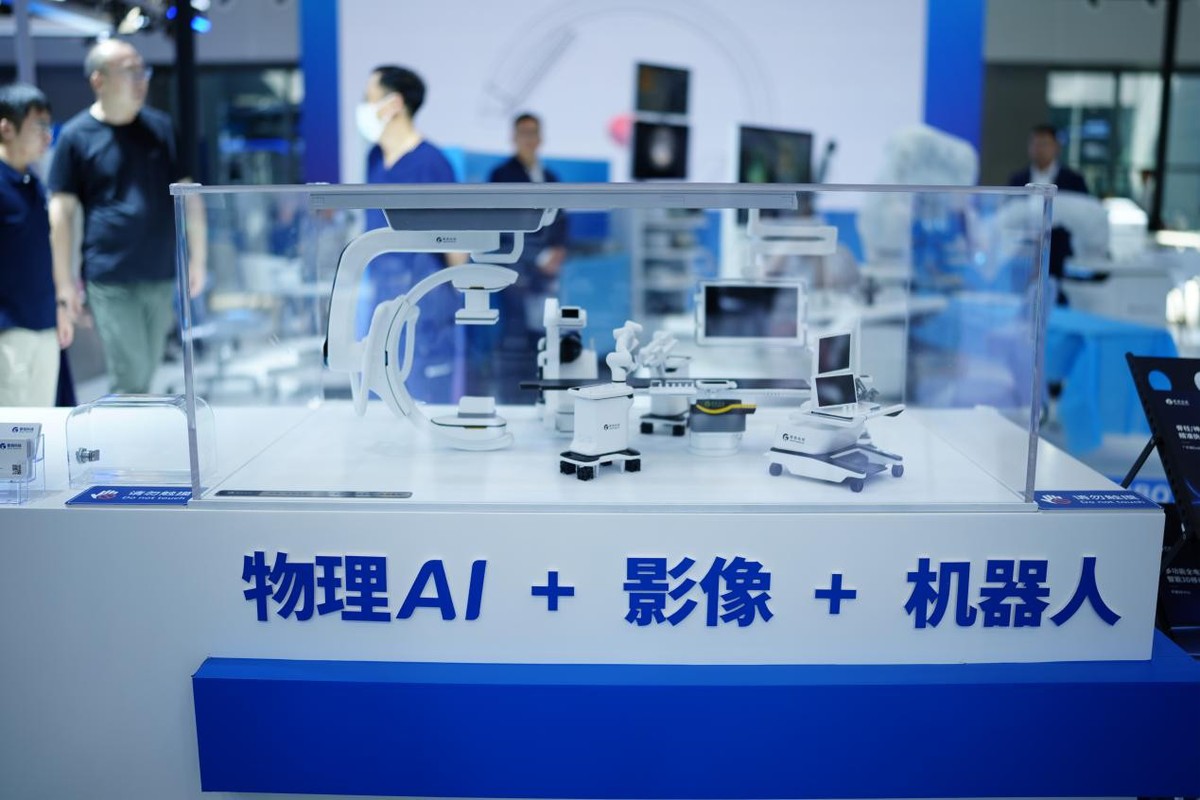
What Great Robotics brought was not a single piece of equipment but the NewDawn X all-domain minimally invasive intelligent platform: the NewDawn Endo Series active surgical robot, NewDawn 3D Series mobile imaging robot, NewDawn Vascular Series intelligent DSA system, and NewDawn META remote robotic surgery system. Together they link image perception, intelligent planning, active robotic execution and teleoperation into one chain — an integrated “Physical AI + Imaging + Robotics” solution.
Three live demonstrations illustrated this approach. Master-slave force control enabled the robotic arm to follow the surgeon’s intent with precision; intraoperative imaging and real-time sensor data fed into a single feedback loop that supports quantitative decisions throughout the procedure; and the telesurgery system showed that high-quality surgical outcomes can be reproduced across regions.
Professor Zhou, MD, a pioneer of minimally invasive spine surgery in China, summed up the technological path in three words: “quantifiable, traceable, optimizable”. With imaging, sensors and robotic control, surgical maneuvers that once depended on a physician’s experience can become digital processes that are recorded, reviewed and continuously improved.
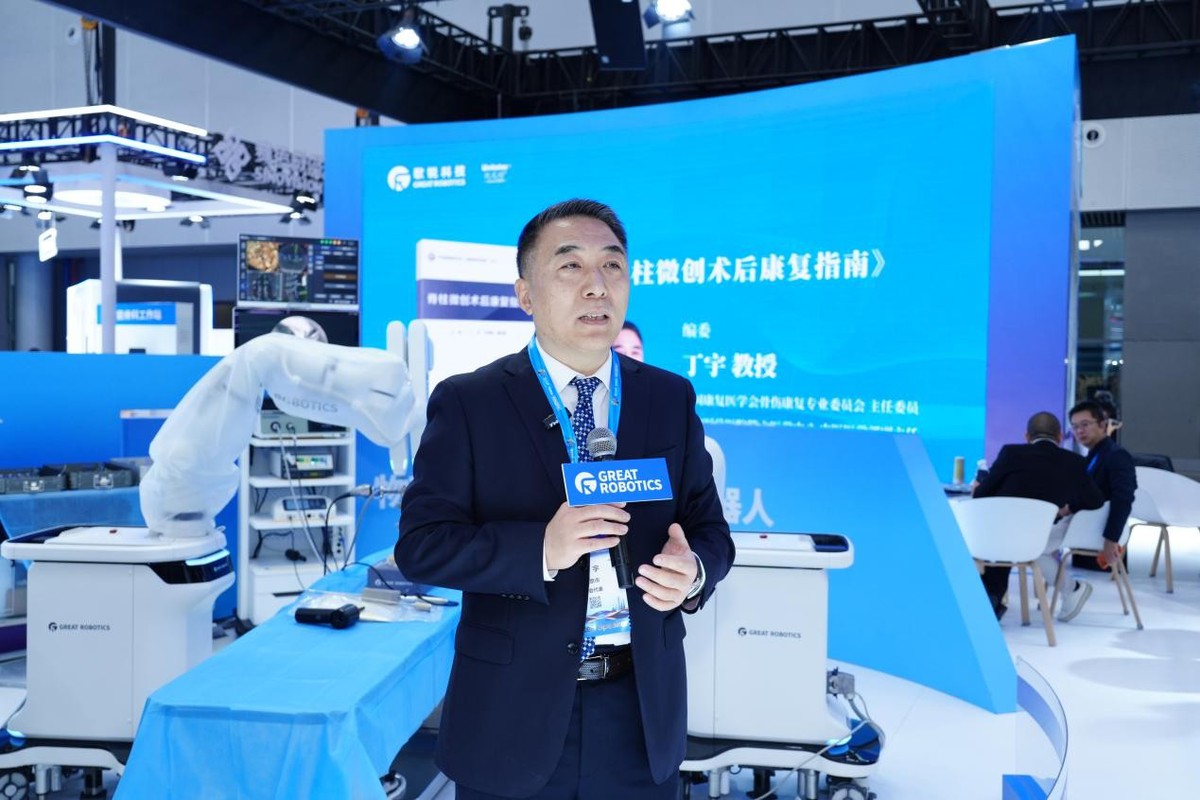
Professor Ding Yu, MD, director of orthopedics at the Sixth Medical Center of PLA General Hospital, put the case for an ecosystem plainly: “Domestic equipment doesn’t need to follow foreign products step by step. What we need is a complete, integrated ecosystem of our own — a unified platform like Great Robotics’ that links imaging, robotics and remote collaboration. That makes it easier to set quality-control standards, run multicenter studies and train surgeons, so these techniques spread in a healthy, standardized way”.
The same logic extends beyond orthopedics. Navigational pathways in neurosurgery and intraluminal trajectories in vascular intervention can be verified through imaging measurements and spatial coordinates. By connecting departments’ workflows onto one shared foundation, Great Robotics is moving from single-specialty tools toward an interdisciplinary platform — the kind of connected care APEC’s health agenda has been pushing for.
Four series, one architecture
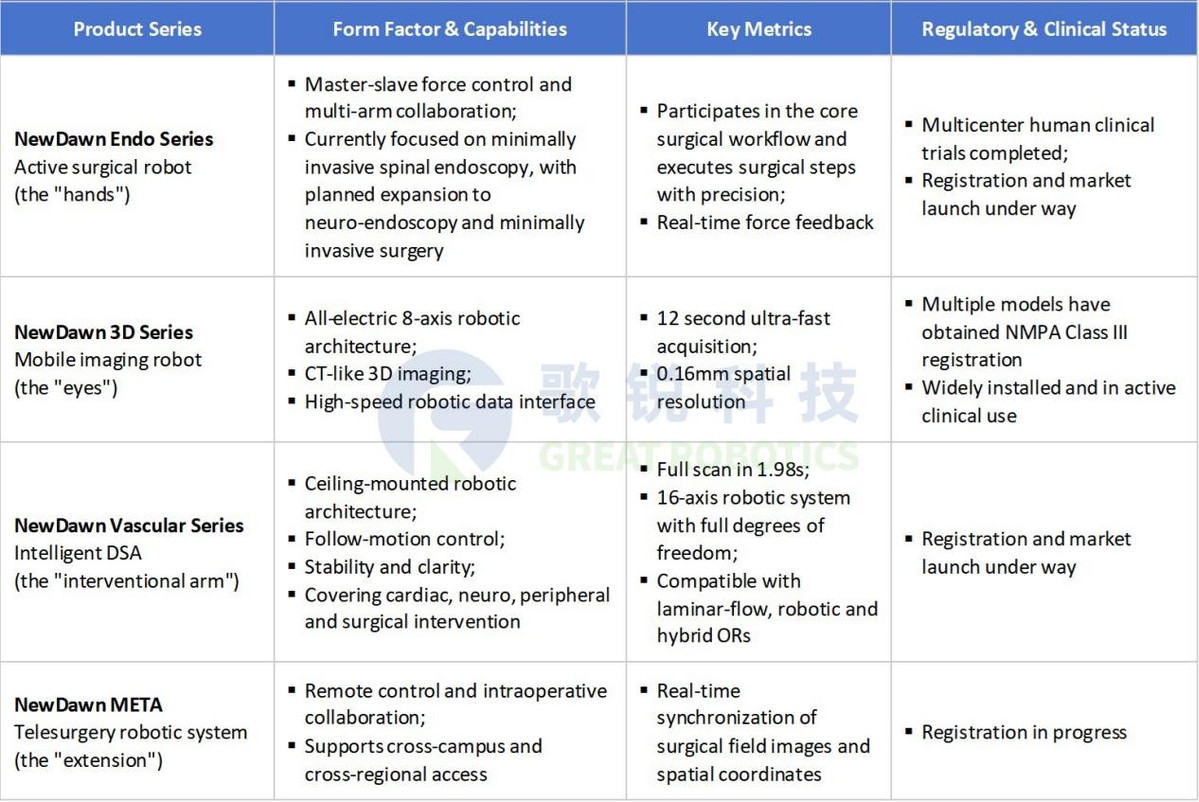
Under NewDawn X, four product series handle perception, execution, intervention and remote collaboration — four ways of accessing one technological foundation across departments.
Each terminal solves one problem: NewDawn 3D sees, NewDawn Endo acts, NewDawn Vascular treats, and NewDawn META extends. Together, the four systems form an ‘all-domain’ platform — four access points to the same foundation across departments, going beyond a collection of products from separate business lines or an upgrade of a single-specialty tool.
Platformization comes down to interfaces. Imaging and execution share one spatial coordinate system, planning software does not have to be rewritten for every discipline, and modules can be added or removed depending on the procedure. In a hybrid operating room, orthopedics, neurosurgery and vascular intervention follow one another on the table, and the coordinate system only has to be established once.
An ecosystem can be judged at three levels: devices can be combined, software can be reused, and procedures can keep expanding. A true ecosystem is not the “grand unification” of a single department; it is only an ecosystem when all three layers sit in the same coordinate system.
One closed loop: scan, compute, act, verify, collaborate
For surgical robots to do more, image acquisition, planning, execution and verification have to be connected. NewDawn X integrates these steps into one system and extends them to remote collaboration.
The value of a complete closed loop lies in efficient coordination between different systems. Great Robotics develops imaging equipment, navigation and planning software, and surgical robots itself, so data exchange and spatial registration can be completed within one architecture, reducing cross-device data conversion and hand-offs between steps.
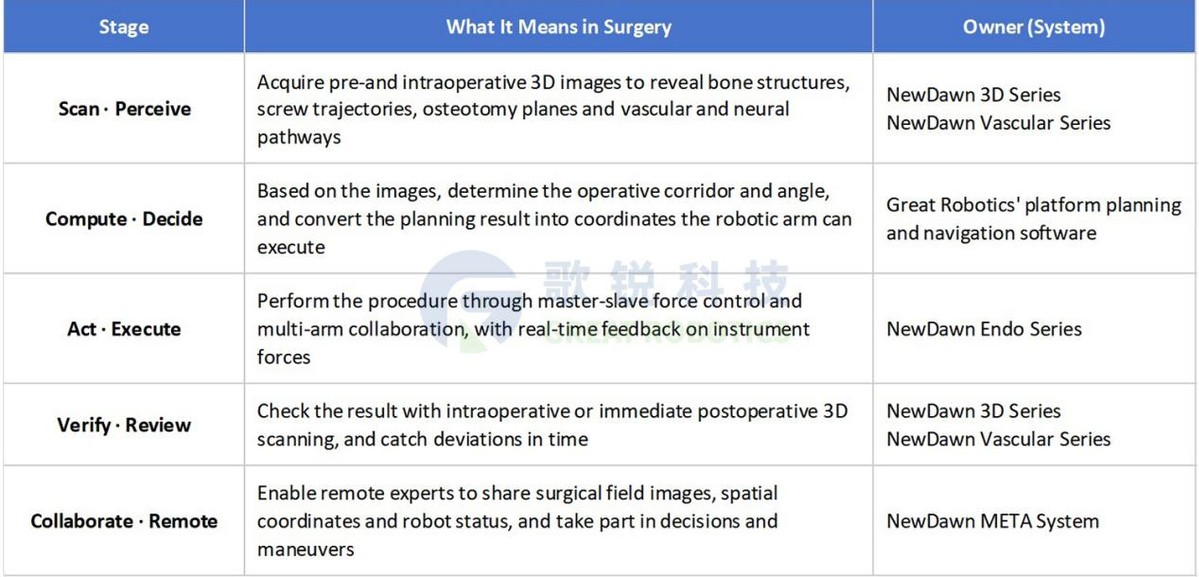
Remote collaboration extends the capability further. Experts at a distance can access synchronized 3D images, spatial coordinates and robotic arm status, and take part in decisions and maneuvers within a unified environment. For APEC economies where specialist coverage is concentrated in major cities, that is not a luxury feature. It is the difference between a technique staying at one hospital and reaching patients elsewhere.
Physical AI: Four Couplings, One Chain
Physical AI does not start with models; it starts with sensors. Great Robotics couples four technologies: a large AI model for medical use that understands procedures and intent, 3D intraoperative imaging that establishes spatial relationships, multidimensional force sensing that turns “feel” into measurable data, and collaborative robotic arms that turn decisions into motion.
Together they form a chain — from visual perception and tissue-deformation prediction to dynamic path correction and active execution. Key computations run on-device, supporting low-latency closed-loop control.
With this framework, the robot goes beyond a predefined path: it senses the surgical field in real time, adjusts to tissue changes and feedback, and collaborates dynamically with the surgeon.
During surgery, the preoperative plan provides the initial path, while real-time perception and feedback help the system adapt to the individual patient. By combining Physical AI with embodied intelligence, Great Robotics enables greater environmental understanding and autonomous operation, giving minimally invasive surgery a solution that is practical to deploy and verifiable.
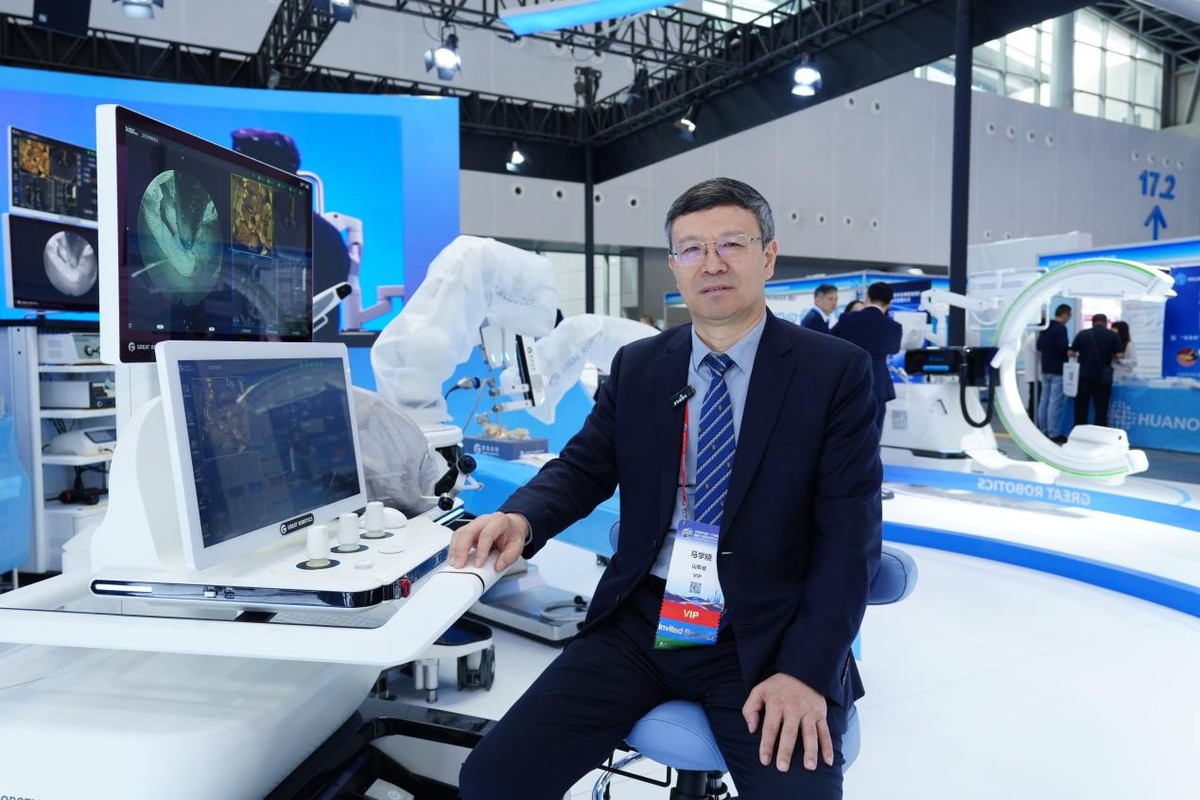
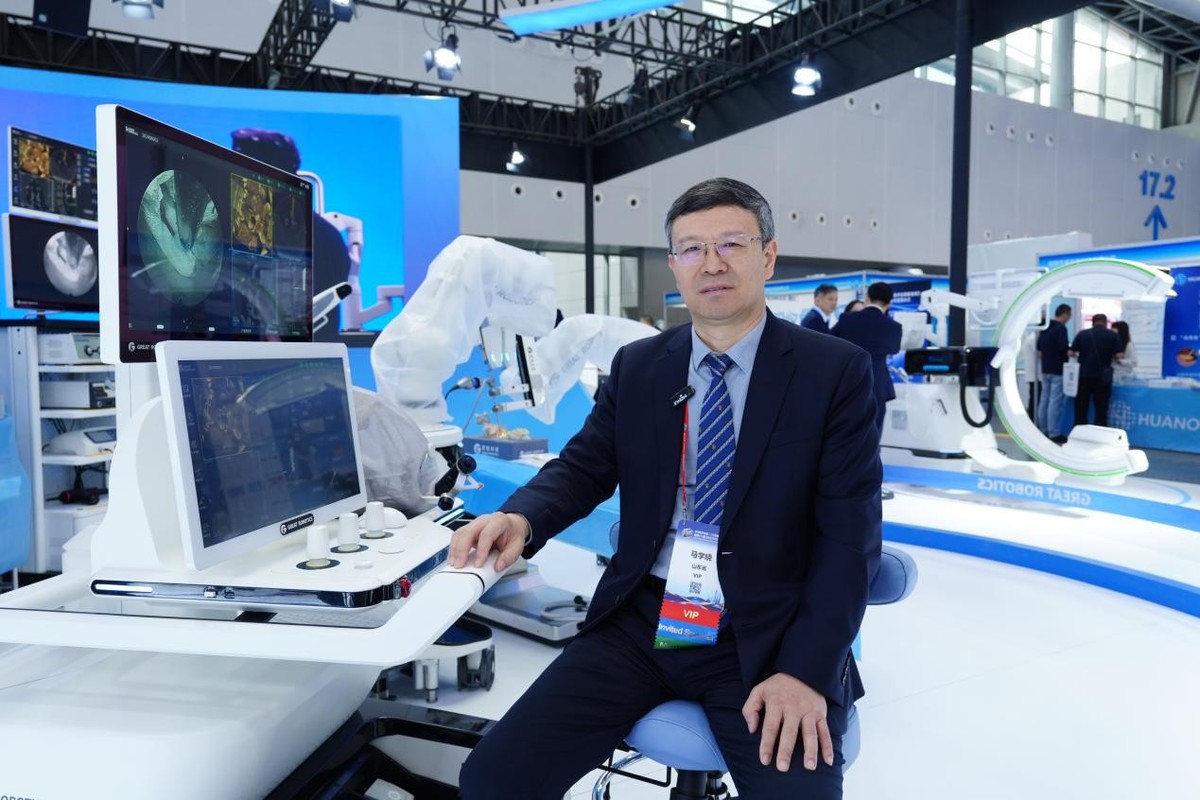
Professor Ma Xuexiao, MD, vice-president of the Orthopedic Hospital at Qingdao University Affiliated Hospital, said: “Much of medical AI stops at preoperative planning and offline image reading. The operating room is a physical environment with strong interference and constant dynamic change — that is exactly what makes Physical AI hard. Great Robotics’ advantage is that AI is not separate from surgery; it is deeply coupled with the imaging system, the robotic arm and force sensing, following anatomical change in real time and adjusting the path dynamically. For flexible procedures such as spinal endoscopy and biportal endoscopy, that dynamic adaptability is the key to breaking through the limits of conventional robots.”
On-device: Keeping judgment inside the operating room
On-device computing is often understood as “making the model smaller”, but that is only the result, not the goal. Great Robotics deploys lightweight AI models in the device’s control hub so that image reconstruction, path planning and arm control are coordinated locally.
Two benefits follow.
First, faster response. Intraoperative 3D reconstruction no longer waits for data to travel over the network — in the OR, seconds and minutes mean entirely different workflows.
Second, local data processing. Raw patient projection data can stay inside the operating room, and the system supports offline reconstruction, reducing reliance on network connectivity and easing hospital data management and deployment across regions.
Through on-device computing, Great Robotics further integrates image processing, planning and robotic control, laying the groundwork for Physical AI in real surgical environments.
Three centers, one answer
The multicenter human clinical trials of the NewDawn Endo Series were completed at Qilu Hospital of Shandong University, Qingdao University Affiliated Hospital and the Chinese PLA General Hospital. The three centers were in different regions, and the trials involved different surgeons, operating room settings and patient profiles. This provided a basis for evaluating clinical applicability and reproducibility.
Professor Liu Xinyu, MD, vice-president of Qilu Hospital of Shandong University and director of its spine surgery department, praised the master-slave force-feedback control and full-procedure participation of the NewDawn Endo Series, saying the technology opens a new direction for orthopedic diagnosis and treatment.
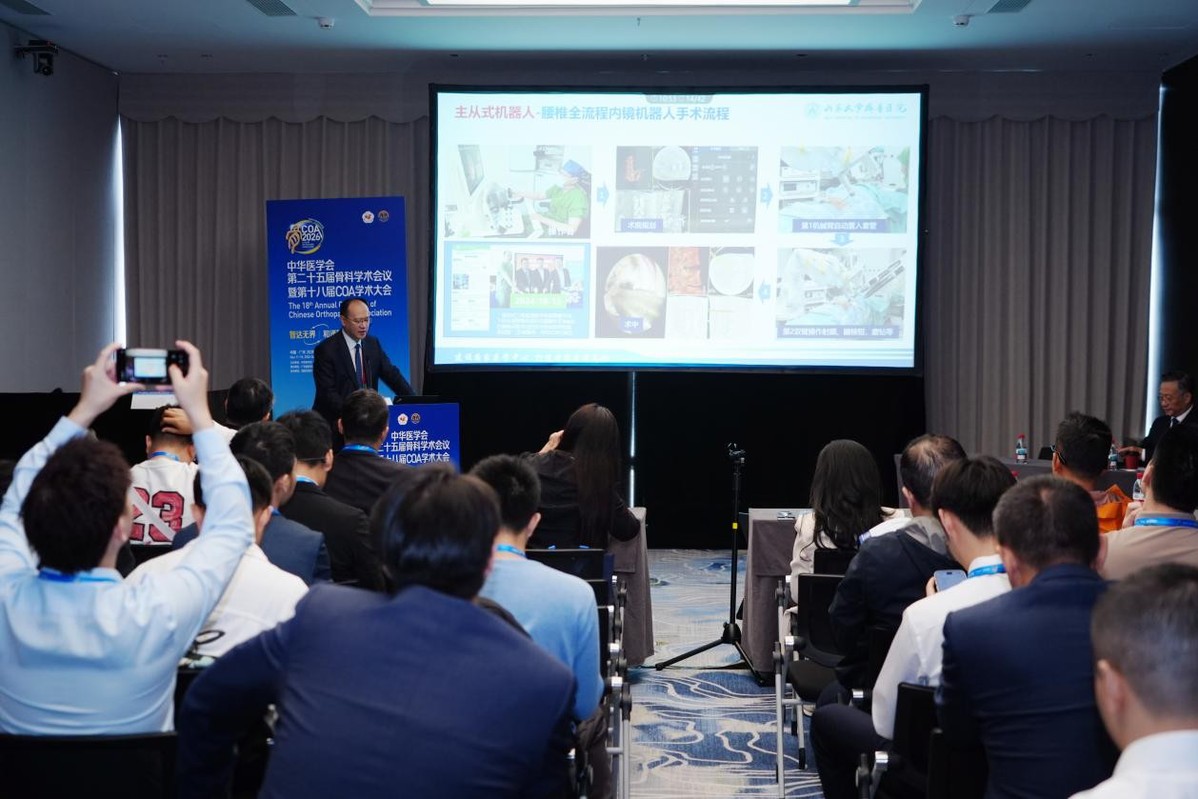
Orthopedics is a key field where Great Robotics advances clinical validation. On its unified platform, the company is extending image perception, active execution and remote collaboration to more minimally invasive scenarios.
Physical AI opens a new era of intelligent surgery
The next step for intelligent healthcare is giving AI the ability to interact with the physical world. The integration of imaging, algorithms, sensors and robotic actuators will let intelligent systems take part in more complex procedures, creating new space for precision surgery and multidisciplinary care.
That direction aligns with what APEC economies have been building toward: innovation that is people-centered and AI that is “for good.” For Great Robotics, that means Physical AI is not an end in itself, and an ecosystem is not a product strategy. Both are means to a practical good: surgical care that is safer, more consistent and more widely available.
The company will keep advancing original R&D, clinical translation and industrial collaboration around the NewDawn X platform. From a single device to an intelligent system, and then to an open industrial ecosystem, Great Robotics aims to move China’s original intelligent surgical technology toward broader clinical application and global markets — not by chasing product benchmarks one by one, but by building the kind of platform that lets quality outcomes travel further than any single machine can reach.